|
Fabric Group
|
Description
|
Shapes
|
Chronology
|
Distribution
|
|
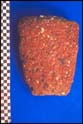
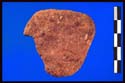
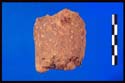
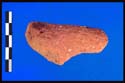
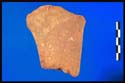
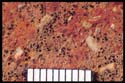
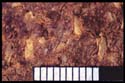
7. Hamburger
|
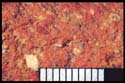
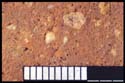
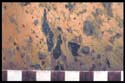
A Redbrown fabric with large dense grits of mixed metamorphic origin.
Quartz makes up more than 1/2 the mix and occurs in sizes up to
4mm and 5mm. Quartz phyllite can also occur in these sizes, and
phyllite flakes may range up to 7mm in size. Small amounts of glassy
quartz, claystone, chert, ferrous, silver mica and gabbro may also
be present.
|
This fabric is most frequently found in tripod feet, pithos rims,
and other large shapes.
|
A variant of Mixed Metamorphic and difficult to date. At present
we can date this fabric no better than Middle Minoan-Late Minoan
III.
|
Sphakia Regions 3 (1), 4 (1), 5 (2), 6 (1), and 8 (13). Clearly,
it is more common in eastern Sphakia.
|
|
|
| |
|
8. Mixed Metamorphic Family Calcareous
|
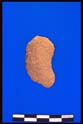
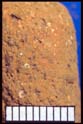
A red brown to orange brown fabric with mixed metamorphic grits
and occasional medium to large calcareous. Other inclusions are
silver mica--/ milky quartz/ calcareous/ phyllite/ schist-.
|
Tripod Cooking pots.
|
Possibly a Neopalatial fabric, but may continue through Late MInoan
III.
|
Loutro Mill (5.15) (1), Khora Sphakion Gravel pit (6.16) (5), Patsianos
Village (8.42) (1). A fairly localized fabric in Sphakia. Largely
confined to Regions 6 and 8.
|
|
|
31/20-21.1P01-32
|
|
|
|
FK Thermokipi (8.53)
|
|
|
|
| |
|
|
|
|
| |
|
|
|
|
|
9. Mixed Metamorphic Family Coarse-fine
|
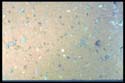
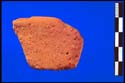
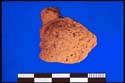
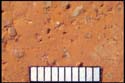
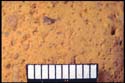
This is not so much a fabric type as a ware, as it is dependent
on a difference in inclusion density between the body and the attachment
(handle, pellet, boss, foot). In each case, inclusions are a metamorphic
mix of quartz, phyllite, soft red claystone, felspar, rusty red
felsic, ferrous, sandstone or silver mica. The finer body usually
has smaller inclusions sizes. The coarser part ranges from 20-40%
density. Paste can range from orange to buff.
|
This feature seems to be found on jugs/jars, but there are a few
tripod feet from Birmani (7.12). The reason for this temper density
variation could be cosmetic or functional.
|
At present we are dating this Ware to Middle Minoan-Late Minoan.
|
It is distributed primarily in the eastern end of the survey area:
Region 5 (2), 6 (3), 7 (3) and 8 (19). A few examples have been
noted in the Ag. Vasilios Valley Survey Project area, but they are
in a different fabric. None in the Vrokastro area.
|
|
|
31/20-21.1P07-37A
|
31/20-21.1P07-37B
|
31/20-21.1P11-07
|
|
FK Thermokipi (8.53)
|
|
|
|
| |
|
|
|
|
| |
|
10. Oatmeal Nut
|
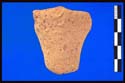
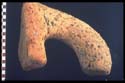
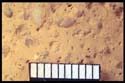
A buffish surface with a pink core. The clay matrix or paste is
usually well levigated and powdery on the surface. Similar to Silver-blue
Spotted Ware, but much coarser to touch because of the protruding
grits of quartz and quartz phyllite. The paste is full of feldspar.
|
Mainly jars.
|
Mainly associated with Late Minoan III-Early Iron Age sites. May
continue as late as Archaic.
|
Not common in Sphakia, but with a very specific distribution.
This fabric may well be imported from Ag. Vasilios Valley Survey
Project, where it is very common on Early Iron Age-Archaic sites
|
|
|
31/20-21.1P01-45
|
|
05/26.1P11
|
|
FK Thermokipi (8.53)
|
|
Biri Avlochi (7.09)
|
|
| |
|
|
|
|