|
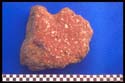
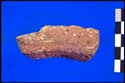
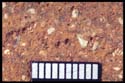
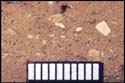
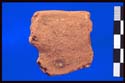
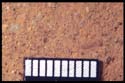
11. Greasy Blue Phyllite
|
A rosy red to red surface with a greyish or same coloured core.
The surface has a distinctive "greasy" feel and burnishes easily.
The grits are blue to pink in colour and have been identified by
petrography as phyllite.
|
Usually handbuilt thick bodied sherds, but it can also occur in
thinner, carefully worked shapes, including a small footed shape
(Aradena (3.20) P05), and 2 examples of herringbone incised decoration
(Livaniana Akropolis (5.01) P09).
|
Most likely Late Minoan IIIC to Geometric-Archaic.
|
In Sphakia this fabric is not terribly common except at one site:
Potamos Kitrogiannis in the Madhares (2.01). It occurs in small
quantities at most of our "Early Iron Age" sites (exceptions include
Biri Avlochi, Goni Cistern, West of Old Ag. Roumeli). It occurs
at Hyrtakina (Greek-Roman) in Selino to the west, and at Myrthios
Kirimianou (Early Iron Age) in Ag. Vasilios to the east (It is unknown
on any other Early Iron Age sites in Ag. Vasilios). Moody has also
seen this fabric in material from the Gavdhos Survey directed by
Katerina Kopaka.
|
|
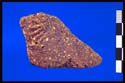
12. Coconut Ware
|
A very hard,thin,redbrown to pinkish (5yr6/4) surface with a dark
grey core (2.5yr5/0) with large (up to 7.5mm), slightly lustrous,
white rhomboidal shaped inclusions, identified by petrography as
phyllite. Other inclusions can include ferrous rocks, and sandstone.
Always wheelmade. Raised band with stamped rosette.
|
Large jars, jugs.
|
The likeliest date for this fabric is Early Greek (Geometric-Archaic?)
|
Sphakia Regions 2, 3, 4, 5, 7. Most common in the west and north,
suggesting its source to be Selino. It occurs at the Early Iron
Age citadels of Kolokasia Kastello, and Myrthios Kirimianthou and
the Greek city of Hyrtakina.
So far, one or two pieces from Early Iron Age-Greek sites in Ag.
Vasilios Valley Survey Project. Unknown in Vrokastro Survey Project,
but Moody has seen an Archaic pithos in the Sitia Museum made of
this fabric.
|
|
13. Phyllite Cooking
|
Brown to redbrown surface with a red brown cores. Dense, large
phyllite inclusions. Quartz is also present, along with felspar,
qf, claystone, or traces of silver mica. Particle sizes range up
to 2mm and densities are 30%.
|
Cooking basins and tripods.
|
This fabric is commonest on sites with Late Minoan material
|
Sphakia Regions 2 (2), 3 (1), 4 (3), 5 (2), 6 (1), 7 (1), 8 (1).
The common cooking ware in western Sphakia (basins, tripods, etc.),
but in east Sphakia, where the common cooking ware is mixed metamorphic,
it shows up only in the basin shape.
|